
Ask a Roomba to clean your house, and it will do a decent job. It won’t be artistic, it won’t be creative, but the floor will be clean. Ask ChatGPT to write an essay, and it will do the same thing. It will be grammatically perfect. The structure will be logical. The spelling will be flawless.
But it will also be incredibly boring.
In our second post on Re-thinking thinking: Authentic Intelligence, we need to talk about the “Vanilla Trap.” This is the subtle danger of letting algorithms do our writing: we aren’t just losing the ability to write; we are losing the ability to sound like individuals.
The Science of “Average”
To understand why AI writing feels so bland, you have to know how it works. Large Language Models (LLMs) are essentially “autocomplete” on a massive scale. When you ask a chatbot a question, it predicts the next word based on probability.
It looks at billions of sentences to find the most likely combination of words.
- Human creativity often lives at the edges—it’s the unexpected metaphor, the strange turn of phrase, or the risky argument.
- AI generation lives in the fat middle of the bell curve. It always chooses the “statistically probable” path.
When a student uses AI to polish their work, the software acts like a sander. It sands down the “rough edges”—the slang, the regional dialect, the tentative ideas, and the weird jokes. It leaves behind a smooth, polished surface that looks professional but feels like a corporate press release.
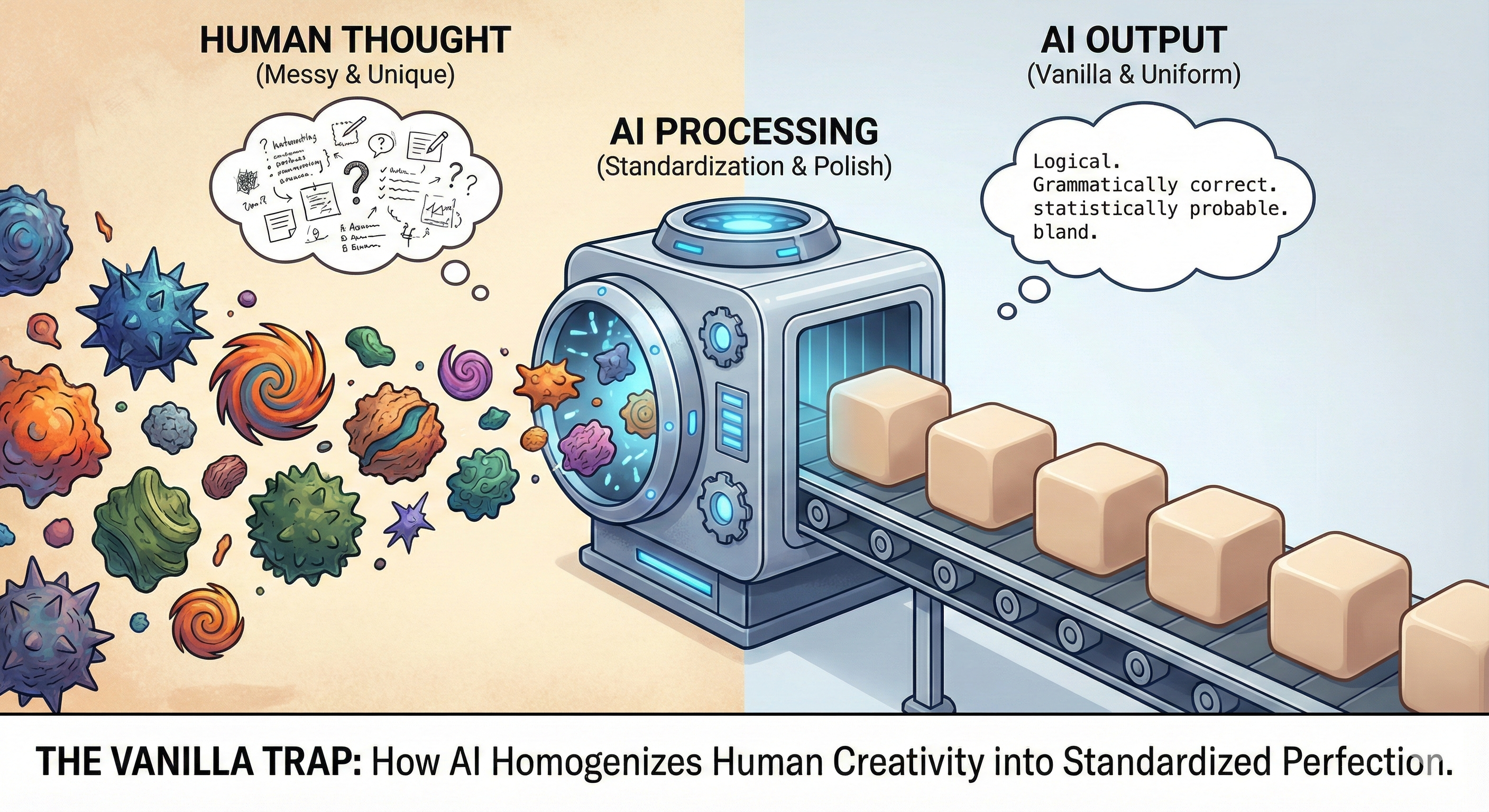
Why “The Average” is Dangerous for Innovation
You might ask: “What’s wrong with polished writing?”
The problem is that universities are supposed to be incubators for new ideas. If every student uses a tool that pushes them toward the statistical average, we create a “Feedback Loop of Sameness.”
- Loss of Voice: A student from rural Belgium shouldn’t sound like a student from downtown New York. But AI makes them both sound like a generic, stunningly polite assistant.
- Risk Aversion: Great breakthroughs happen when someone says something unlikely. AI is designed to say what is likely. If we rely on it, we stop taking intellectual risks.
We are facing a future where 50 essays on a professor’s desk all sound vaguely identical: perfectly competent, yet devoid of a human soul.
The Solution: Grade the Process, Not the Product
So, how do we encourage students to embrace their own “weird” human voice? We need to stop rewarding the final polish and start rewarding the messy journey.
Here are three strategies for Authentic Intelligence in the classroom:
1. The “Track Changes” Requirement
Don’t just ask for the final PDF. Ask to see the evolution.
- The Strategy: Require students to submit their “messy middle”, the rough notes, the crossed-out paragraphs, and the bad first drafts.
- The Lesson: Authentic thinking is messy. If a student produces a perfect essay in one hour without a single edit, it’s a red flag. We value the struggle of the edit.
2. The “Personal Angle” Rule
AI knows the entire internet, but it doesn’t know you.
- The Strategy: Design assignments that require a personal connection. Instead of “Analyze 19th-century economics,” ask: “Connect a concept from 19th-century economics to a specific conversation you had with a family member or a job you have held.”
- The Lesson: This forces the student to synthesize external knowledge with internal experience, something AI cannot fake (yet).
3. “Critique the Machine”
Turn the AI from an author into a subject.
- The Strategy: Have the class generate an AI answer to a complex question. Then, spend the seminar analyzing it. “Where is this answer too safe? What perspective is it missing? How is the tone too generic?”
- The Lesson: This positions the student above the algorithm. It teaches them that the AI output is the “floor,” not the “ceiling.”
The Bottom Line
In a world of artificial perfection, imperfection is a premium asset.
We want to hear our students’ actual voices, stumbles, quirks, and all. Because a unique, slightly messy human idea is worth infinitely more than a grammatically perfect hallucination.
 Tom Van Woensel