Let’s imagine two students in the same Introduction to Political Science course. They both have a major paper due tomorrow.
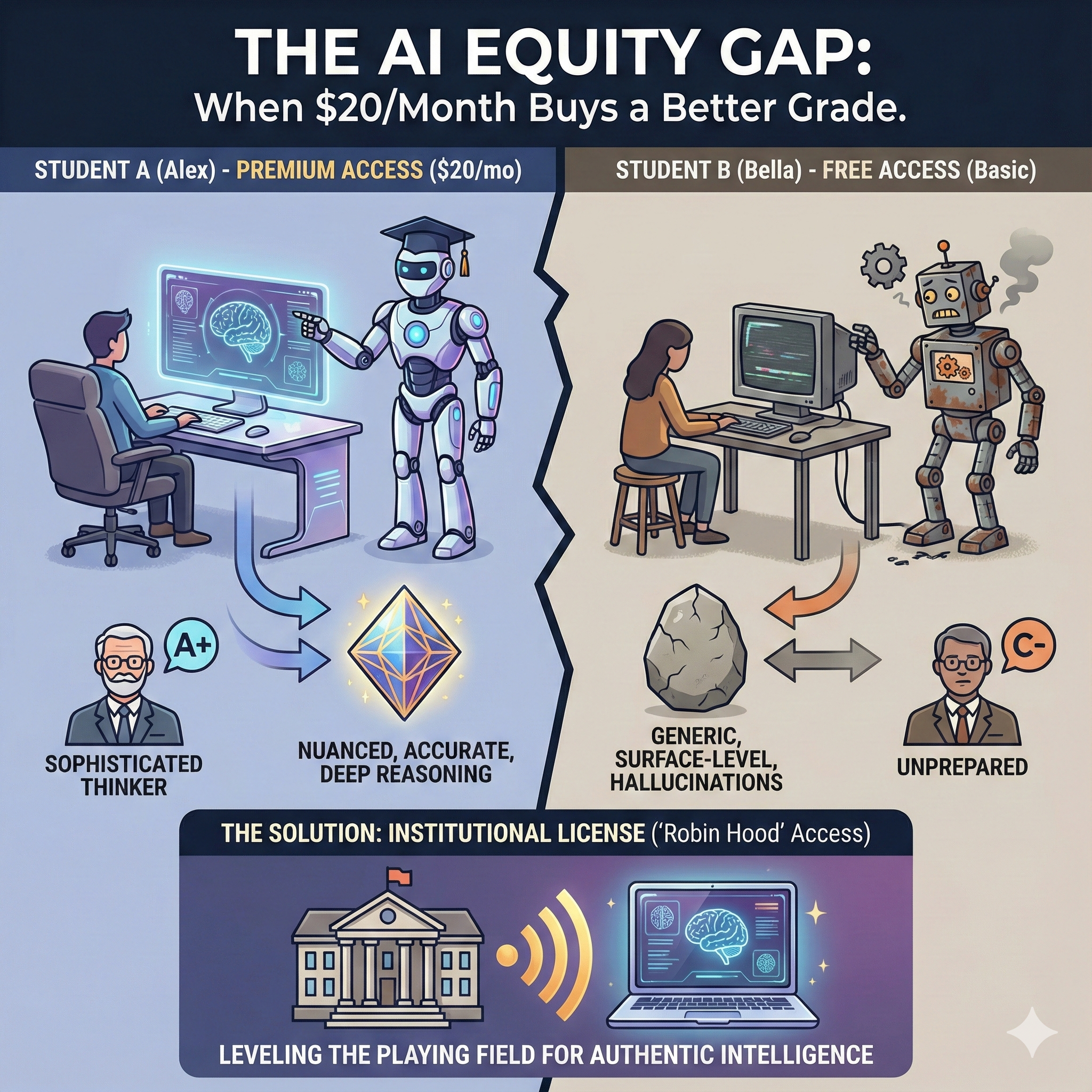
Student A (let’s call him Alex) sits in his dorm room. He pays €20 a month for a premium subscription to the latest, most powerful AI model (like GPT-4 or Claude 3 Opus). He feeds it his rough outline. The AI understands complex nuances, identifies a flaw in his logic regarding international law, and suggests three highly relevant, recent academic sources for exploration. Alex spends the next four hours refining those intricate points.
Student B (let’s call her Bella) is in the library. She relies on her financial aid package for tuition and doesn’t have €20 a month extra for software. She uses a free, older AI model on the library computer. She feeds it the same outline. The free model misses nuance, provides her with a generic summary of political theory, and “hallucinates” (invents) two sources that do not exist. Bella spends the next four hours chasing down fake citations and trying to make a generic argument sound interesting.
When the professor grades the papers, Alex appears to be a sophisticated thinker. Bella looks unprepared.
But Alex isn’t more brilliant than Bella. Alex is just richer.
In our third post on Re-thinking thinking: Authentic Intelligence, we need to confront an uncomfortable reality: AI is not a “great equalizer.” Without strategic intervention, it is poised to become the most powerful engine of inequality in higher education.
The “Smart AI” vs. “Dumb AI” Divide
We used to talk about the “Digital Divide” in terms of hardware—who had a laptop and who didn’t. Universities have addressed this mainly with computer labs and laptop loan programs.
The new divide is cognitive. It’s about access to the best reasoning tools.
Many people assume “AI is AI.” This is false. The gap between current free models and current paid models is massive.
- Premium Models: Have deeply improved reasoning capabilities, can handle much larger amounts of text, reduce “hallucinations” (errors) significantly, and are better at mimicking specific tones.
- Free Models: Are often based on technology that is 1-2 years old (an eternity in AI time), frequently confident but wrong, and produce bland, repetitive output.
If we do nothing, we are creating a two-tiered education system. Tier One gets a tireless, genius-level 24/7 tutor for a monthly fee. Tier Two receives a buggy, unreliable assistant that might mislead them.
Why Banning is a Tax on the Poor
Some might argue: “Well, just ban AI completely! Then it’s fair.”
Banning AI doesn’t stop the wealthy student. Alex will just use his premium AI on his personal laptop in his off-campus apartment, and he probably won’t get caught.
Banning AI only hurts the students who rely on university infrastructure. It forces students who need the most help to conceal their use, preventing them from learning to use these essential tools properly. A ban is essentially a “tax” on disadvantaged students.
The Solution: The University as “Robin Hood”
If our goal is Authentic Intelligence for all students, the university cannot remain neutral. We must actively level the playing field. We need to treat advanced AI not as a luxury cheating tool, but as essential infrastructure—like electricity, wifi, or library access.
Here is a strategic approach to closing the AI equity gap:
1. The “Robin Hood” License (Institutional Access)
The single most effective move a university can make is to purchase enterprise licenses for top-tier AI tools and provide them to every student, faculty member, and staff member for free.
- The Strategy: Negotiate with providers (OpenAI, Microsoft, Anthropic, etc.) for a campus-wide seat license.
- The Outcome: Alex and Bella both get access to the same “super-tutor.” The advantage shifts back from ability to pay to ability to think.
2. Democratizing “Prompt Engineering”
Access to the tool isn’t enough; you need to know how to talk to it. Wealthy students often have tech-savvy networks teaching them the “power user” secrets of AI.
- The Strategy: Integrate mandatory AI literacy modules into first-year seminars. Don’t just teach academic integrity; teach competence. How do you craft a prompt to get a nuanced answer? How do you spot a hallucination?
- The Outcome: We ensure that “digital natives” actually know how to use the tools of their trade effectively and skeptically.
3. Invest in Open Source (Local Solutions)
We should not be entirely dependent on Big Tech pricing models that could skyrocket tomorrow.
- The Strategy: University IT departments should invest in running powerful “open-source” AI models (like Llama or Mistral) on university servers.
- The Outcome: This provides a free, high-quality, and private alternative for students, independent of corporate subscription fees.
The Bottom Line
A university’s mission is to find and cultivate talent, regardless of background. If we allow a €20/month paywall to determine who succeeds in the AI era, we have failed that mission.
Authentic intelligence should not have a price tag.
 Tom Van Woensel