I recently came across Martec’s Law. The premise is deceptively simple:
Technology changes exponentially, but organizations change logarithmically.
Visually, imagine a steep, upward-curving line representing tech (AI, data analytics, digital platforms) and a much flatter, slower-rising line representing how businesses and institutions adapt. The space between those two lines? That is the disruption gap. It is where stress, inefficiency, and missed opportunities live.
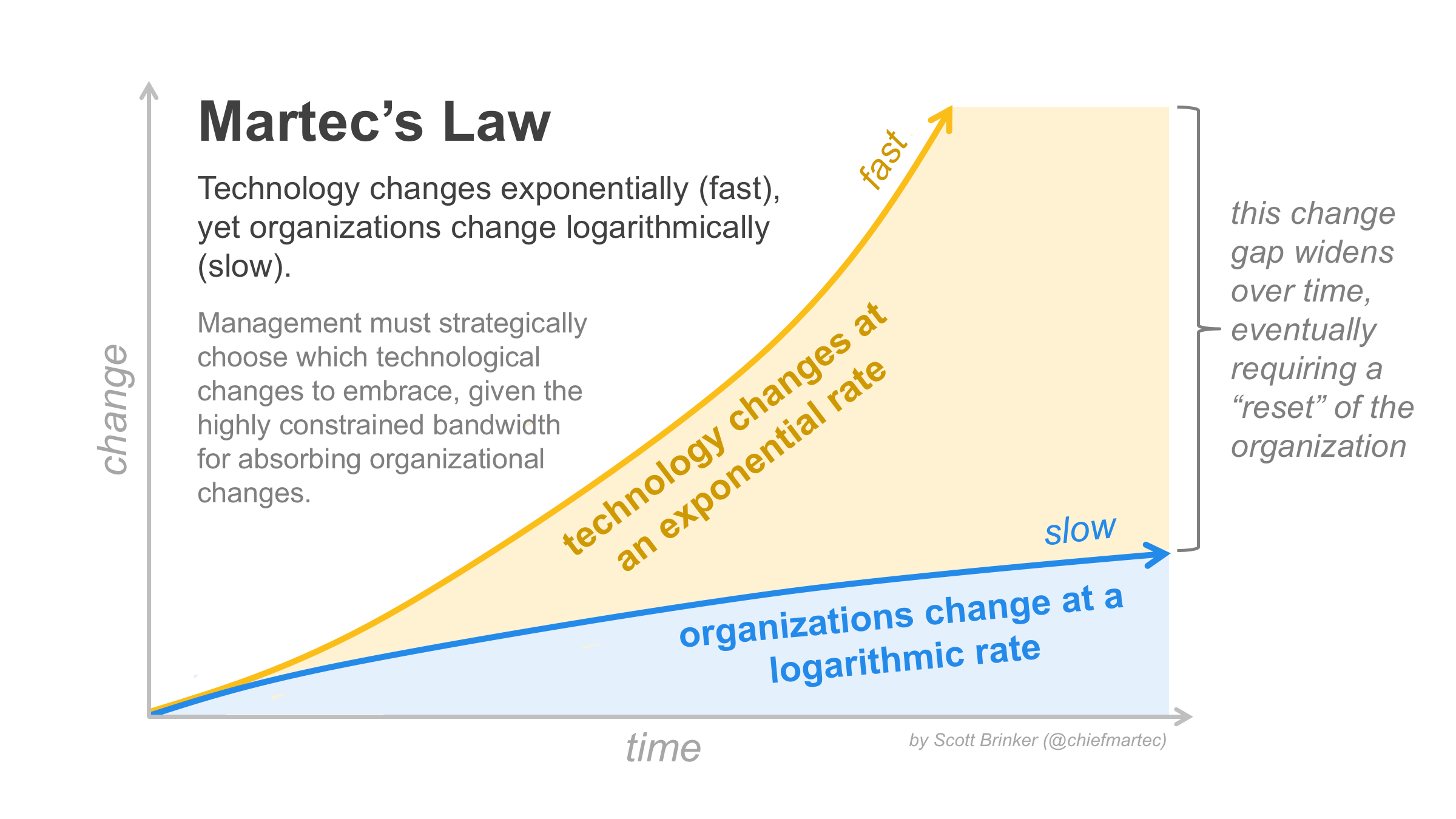
For those of us in academia, this graph hits uncomfortably close to home.
The University as the Ultimate “Logarithmic” Organization
Universities are, by design, institutions of stability. We are built on traditions that span centuries. Our governance structures, committees, peer reviews, and accreditation cycles are engineered for rigor, not speed. We pride ourselves on getting it right, not getting it first.
In many ways, this is our strength. We are the guardians of knowledge, and we shouldn’t be swayed by every fleeting trend. But Martec’s Law poses a unique threat to us in the 21st century. The AI technology we need to use and educate (and the technology our students will face in the workforce) is scaling exponentially. Meanwhile, our decision-making processes remain linear.
We are facing a pressure we aren’t built for: the need to speed up.
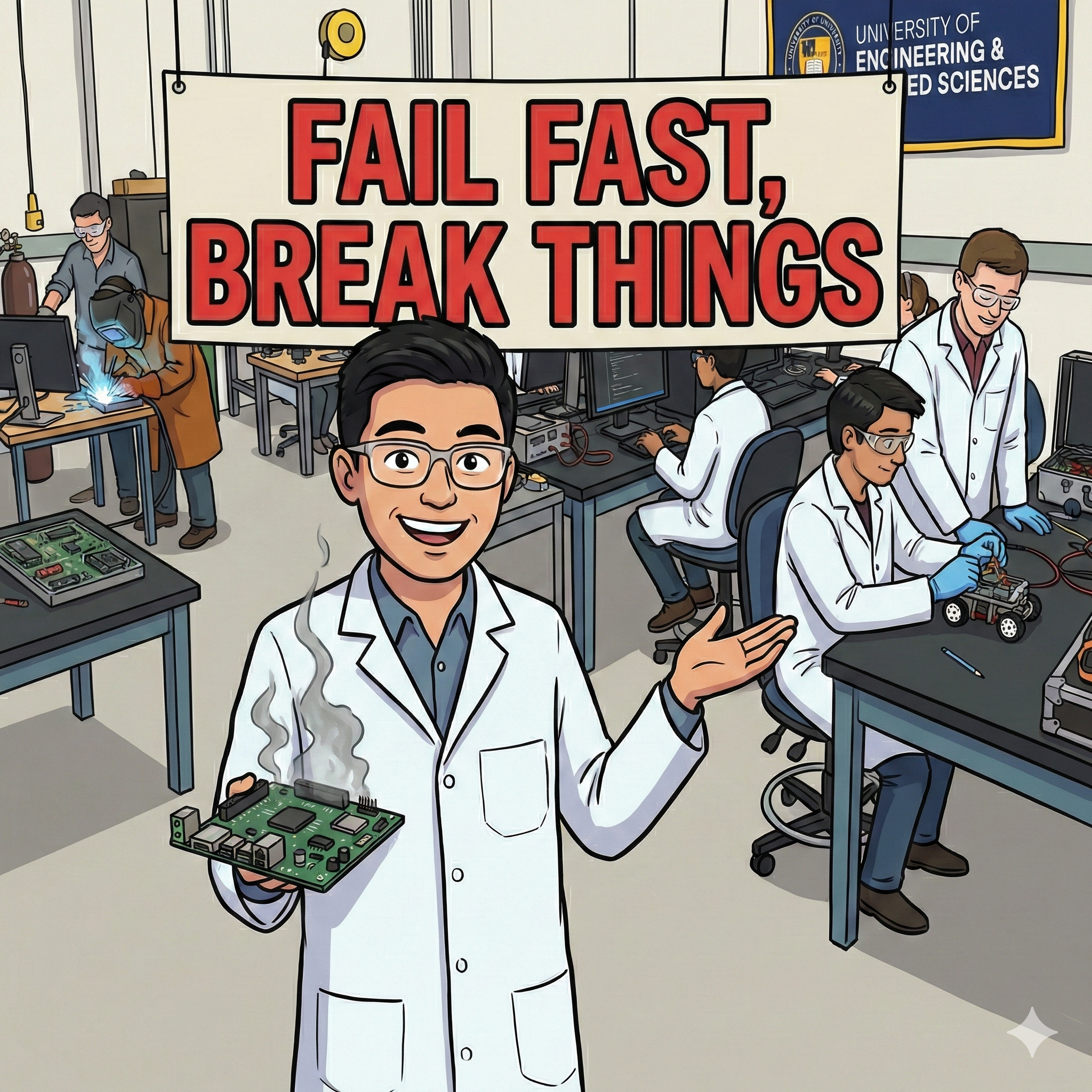
fail fast, break things
The core friction isn’t just bureaucratic; it’s cultural. In the tech world, the driving force behind that exponential curve, “fail fast, break things”, is a mantra. Iteration is expected. A mistake is just data for the next version.
In academia, however, we are allergic to mistakes.
Our professional reputations are built on accuracy. A mistake isn’t an “iteration”; it’s a retraction. It’s a failed grant. It’s a flaw in the methodology. Consequently, we have built systems to prevent errors at all costs. We check, double-check, and form a committee to check again.
But when you apply this zero-error mindset to organizational transformation, like integrating AI into our curriculum or overhauling student administration systems, it becomes a paralyzing brake. We spend years perfecting a plan that is obsolete by the time we implement it.
Strategy is Choice (and Choice Requires Speed)
So, how do we handle this? We cannot simply demand that a university behave like a lean startup overnight. That would break the very structure that makes us valuable.
Brinker suggests that the only way to manage the gap is through choice. We cannot adopt every change. Instead, we must ruthlessly prioritize which AI technological changes to absorb that align with our educational mission.
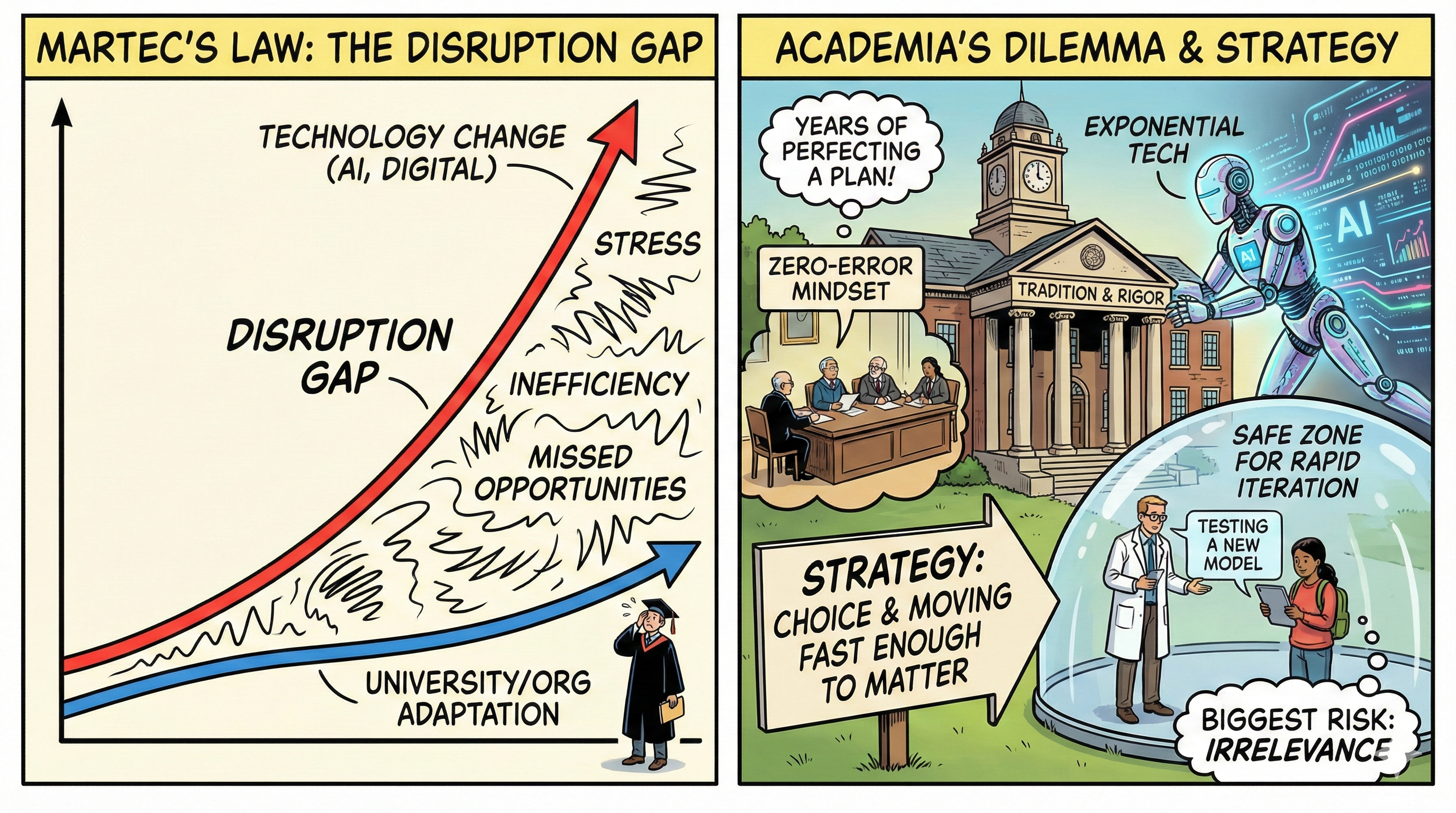
But more importantly, we must fundamentally change our relationship with decision-making. We need to create “safe zones” within our institutions where rapid iteration is allowed, where we can test new educational models or administrative tools without the heavy weight of centuries of tradition crushing the experiment.
We need to become comfortable with a new kind of rigor: the discipline of moving fast enough to matter. We have to learn that in the 21st century, the biggest risk is not making a mistake. It is moving so slowly that we become irrelevant.
 Tom Van Woensel