For centuries, the holy grail of education has been the one-on-one “Master-Apprentice” model. Aristotle and Alexander the Great. A PhD candidate and their thesis advisor. It is the most powerful way a human being can learn.
But it has one fatal flaw: It doesn’t scale. You cannot have a dedicated master for every 18-year-old freshman. So, to educate the masses, we built the industrial university. We put 500 students in a lecture hall, standardized the tests, and accepted that we were trading deep, personal mentorship for mass efficiency.
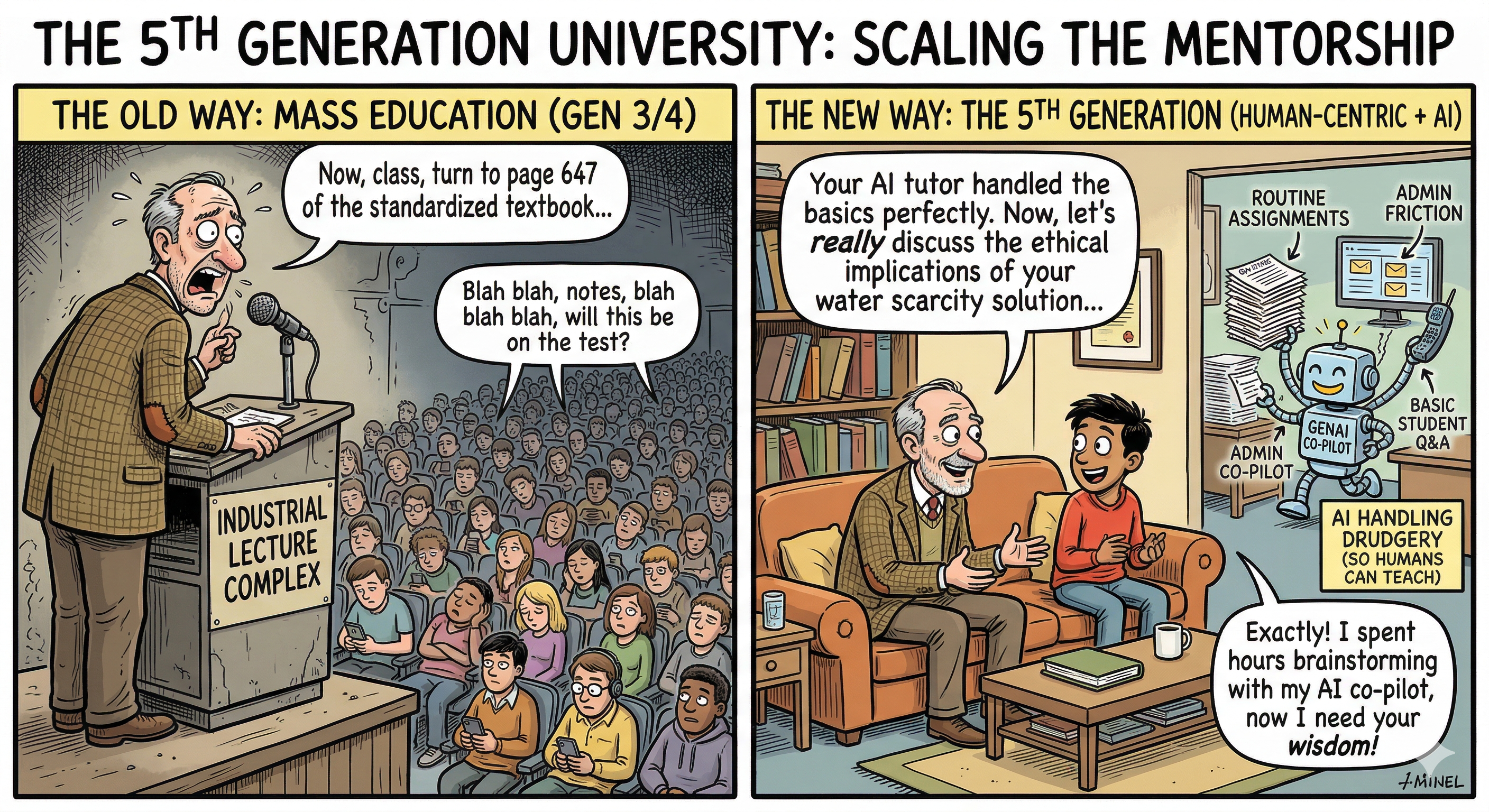
In this post of Authentic Intelligence, we look to the horizon. We are moving beyond the 4th Generation University (which focused on networks and societal challenges) into the 5th Generation University. In this new era, Generative AI acts as an invisible enabler, allowing us to finally put the student and the student-mentor relationship back at the absolute center of the learning process.
The Paradox of High-Tech and High-Touch
There is a profound paradox at the heart of the AI revolution in education: To survive amid hyper-technological change, the university must become hyper-human.
If an AI can deliver a perfectly crafted lecture on supply chain logistics, grade the resulting essay in seconds, and answer the student’s questions at 2:00 AM… what is the professor’s job?
The professor’s job shifts from being a broadcaster of information to a navigator of context.
In the 5th Generation University, GenAI handles the “What” and the “How.” It teaches the formulas, corrects the code, and explains the historical dates. This liberates the human professor to focus entirely on the “Why” and the “What If.”
AI as the “Invisible Enabler” of Mentorship
We often fear that AI will put a screen between the student and the teacher. Used correctly, it actually shatters the screen. Here is how AI enables this radical return to human-centric learning:
1. From Academic Advisor to Cognitive Coach
Currently, a professor’s time is cannibalized by administrative friction and basic grading.
- The 5th Gen Shift: AI tools act as a “Co-Pilot” for the faculty member, summarizing a student’s progress, flagging areas where they are struggling conceptually, and handling routine Q&A.
- The Human Connection: When the student walks into the professor’s office, the professor already knows exactly where the student is stuck. They don’t spend 20 minutes diagnosing the problem; they spend 20 minutes discussing the ethical implications of the student’s proposed solution. The professor becomes a cognitive coach, guiding judgment rather than just testing memory.
2. “N=1” Learning Paths
We have always forced students to fit the curriculum.
- The 5th Gen Shift: AI allows the curriculum to fit the student. An AI tutor can dynamically adjust the reading materials, the pace, and the examples based on a student’s specific background, explaining statistics through the lens of sports for one student, and through the lens of climate science for another.
- The Human Connection: Because the AI ensures the student has mastered the foundational concepts at their own pace, seminar time becomes highly elevated. Students bring their deeply personalized, AI-assisted research to the group, and the mentor facilitates a clash of high-level ideas, rather than teaching to the lowest common denominator.
3. Co-Piloting the Unknown
In the real world, problems are not neatly packaged into textbook chapters.
- The 5th Gen Shift: Assessments move from “Write an essay answering this prompt” to “Use AI to help you solve this impossible problem, and defend your methodology.”
- The Human Connection: The student and the mentor sit side by side, looking at the AI’s output together. They critique the machine. They brainstorm. The mentor models how an expert thinks, how they spot a hallucination, and how they pivot when an idea fails. This is the essence of the master-apprentice dynamic, made scalable.
The Bottom Line
A 5th Generation University recognizes that information is free, but wisdom is expensive. Our students do not need us to read slides to them. They need us to look them in the eye, challenge their assumptions, help them navigate their anxieties about the future, and show them how to apply knowledge with integrity.
AI is not a replacement for the university. It is the ultimate tool to automate the drudgery, so we can finally get back to the deeply human work of actually teaching.
Next Steps:
- For Academic Leaders: Look at your faculty workload models. If we want professors to be mentors, we have to incentivize and reward time spent in one-on-one coaching, not just time spent publishing papers or standing at a podium.
- For Students: Stop viewing your professors as “graders.” Start treating them as mentors. Use your AI to learn the basics, so you can bring your hardest, most complex questions to your human teachers.
 Tom Van Woensel