Walk through the corridors of any university today, and you can feel the chill.
For many educators, the arrival of Generative AI feels less like a technological breakthrough and more like an existential threat. We are staring into an abyss where the very foundations of higher education seem to be crumbling.
The pessimistic view is not just easy to adopt; it is deeply compelling. If a machine can write a flawless essay, solve a complex physics equation, and generate a perfectly structured literature review in the time it takes a student to open their laptop, what is the point of the assignment? We fear cognitive atrophy: the terrifying prospect that by outsourcing the “messy middle” of drafting and struggling, we are outsourcing human thought itself.
We envision a sterile, automated campus where students converse with agreeable chatbots instead of challenging peers. We worry about the homogenization of the human voice, where the brilliant quirks of individual expression are sanded down into a bland, corporate monoculture. We see an arms race of plagiarism and detection, eroding the fundamental trust between mentor and apprentice.
If this is the future of education, it is a bleak one.
The Danger of the Standstill
But here is the critical pivot we must make: This terrifying vision only comes true if we surrender. And ironically, the fastest way to surrender is to ban the technology entirely.
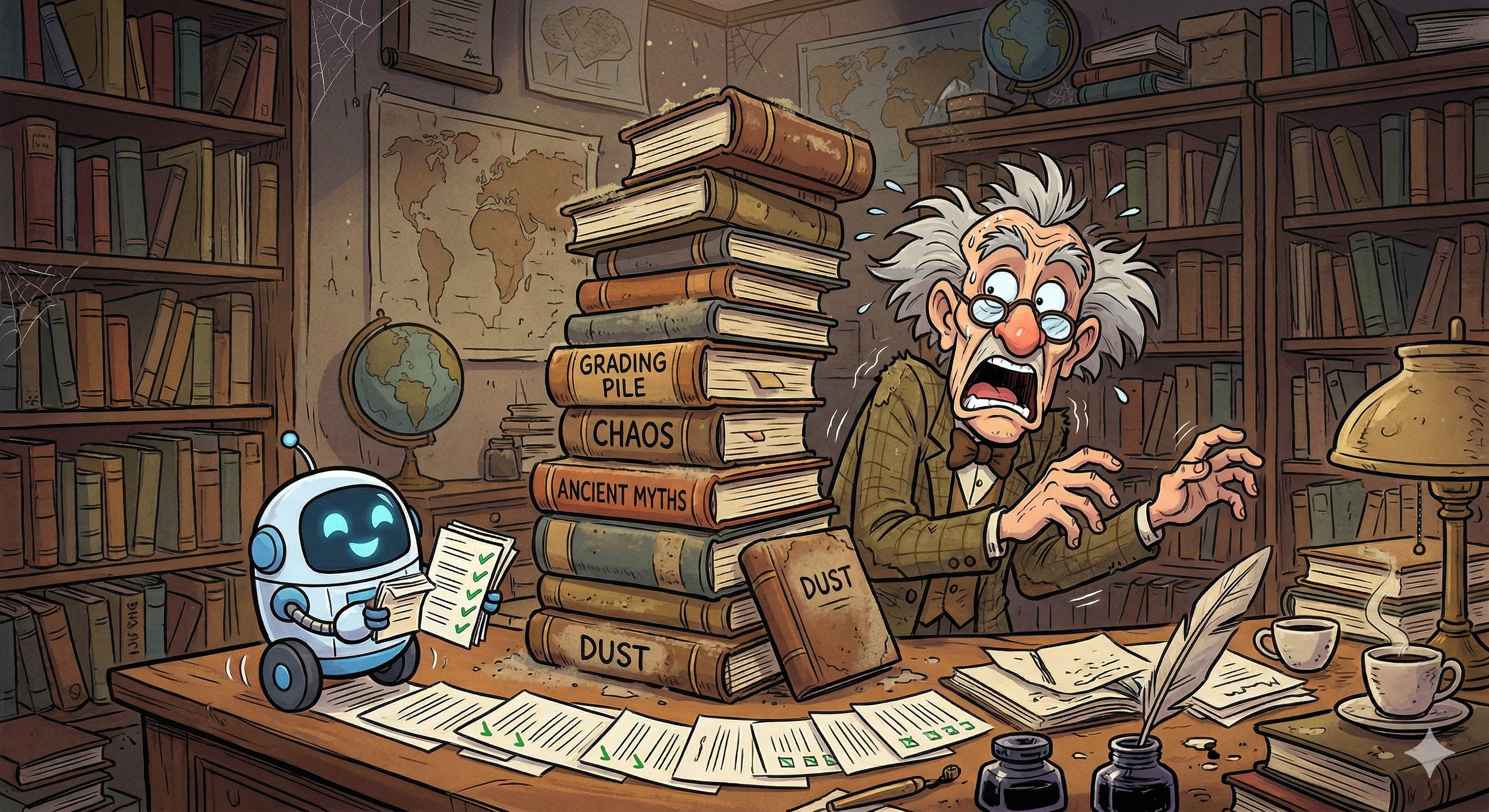
As tempting as it is to build firewalls, block the IP addresses, and retreat to in-class, pen-and-paper exams, choosing not to use AI in education is a profound mistake. It is not a principled stand; it is a standstill.
If we choose to freeze our pedagogy in 2019, we are committing academic malpractice. We would be preparing our students for a world that no longer exists. The global economy, scientific research, and civic discourse are already being fundamentally rewired by AI. To graduate students who are “AI-ignorant” is to send them into a hurricane without a compass.
More importantly, rejecting AI is a massive, generational loss opportunity to build the Next-Generation University.
The Horizon: The Human-Centric Renaissance
When we push past the initial panic, a radical and optimistic truth emerges: AI does not threaten human education; it threatens the industrial model of education.
For a century, we have structured universities around the transfer of knowledge and the assessment of rote skills. We tested memory, basic syntax, and formula application because that was all we had the time and scale to test. AI has now commoditized those things. Information is free. Generation is instant.
This is not a loss. It is a liberation.
If the machine can do the heavy lifting of information retrieval and basic structuring, we are finally free to elevate the classroom. We can transition from the “Information Age” to the “Wisdom Age.”
1. Elevating the “Why” Over the “What”
When AI can answer the “what” and the “how,” the classroom becomes the sanctuary for the “why.” Instead of spending a seminar defining concepts, students can arrive having used their AI tutors to master the basics. The seminar time is then spent debating the ethics, the gray areas, and the human impact of those concepts. We stop teaching students to act like computers and start teaching them to be philosophers, leaders, and critics.
2. Scaling True Mentorship
The greatest casualty of the modern university was the master-apprentice relationship. We replaced it with the 500-person lecture hall. AI gives us the power to bring it back. When AI co-pilots handle the administrative drudgery, initial feedback loops, and basic Q&A, faculty members regain their most precious resource: time. We can return to deep, one-on-one mentorship, looking students in the eye and guiding their judgment, not just their grammar.
3. Building “Authentic Intelligence”
By integrating AI, we force our students to develop a higher order of critical thinking. We teach them that the machine’s output is not the finish line; it is the starting line. They learn to interrogate algorithms, spot hallucinations, synthesize massive amounts of data, and inject empathy and ethical boundaries into synthetic processes. We teach them Authentic Intelligence.
The Choice Ahead
We are standing at a crossroads. Down one path is a reactionary retreat, where we cling to outdated methods out of fear, gradually rendering our institutions irrelevant.
Down the other path is the Next-Generation University. It is a place that leverages the most powerful technology in human history, not to replace the human mind, but to challenge it. It is a university where technology is invisible, and the human connection, the debate, the mentorship, and the shared struggle to discover meaning are central.
We cannot put the genie back in the bottle. Nor should we want to. The future belongs to the educators and institutions brave enough to stop fearing the machine and start using it to rediscover what makes us human.
 Tom Van Woensel