For decades, we have operated what we might call the 3rd- and 4th-Generation Universities. We built entrepreneurial hubs to create economic value, and we built networked ecosystems to tackle complex societal challenges through interdisciplinary research. We engineered incredible systems.
But as we look toward 2030, leading the transformation of our educational programs requires a fundamental paradigm shift. We are no longer just upgrading our technology; we are upgrading our purpose.
We are entering the era of the 5th Generation University: The Hyper-Personalized, Human-Centric University. As the portfolio of artificial intelligence expands into every corner of academia, the knee-jerk reaction is to assume the institution will become colder, more automated, and more distant. The reality must be the exact opposite. If we deploy Authentic Intelligence correctly, the university of 2030 will be the most deeply human institution we have ever built.
Here is a blueprint for how a university must evolve across its three core pillars: Education, Research, and Impact & Valorization.
1. Education: Scaling the Master-Apprentice Model
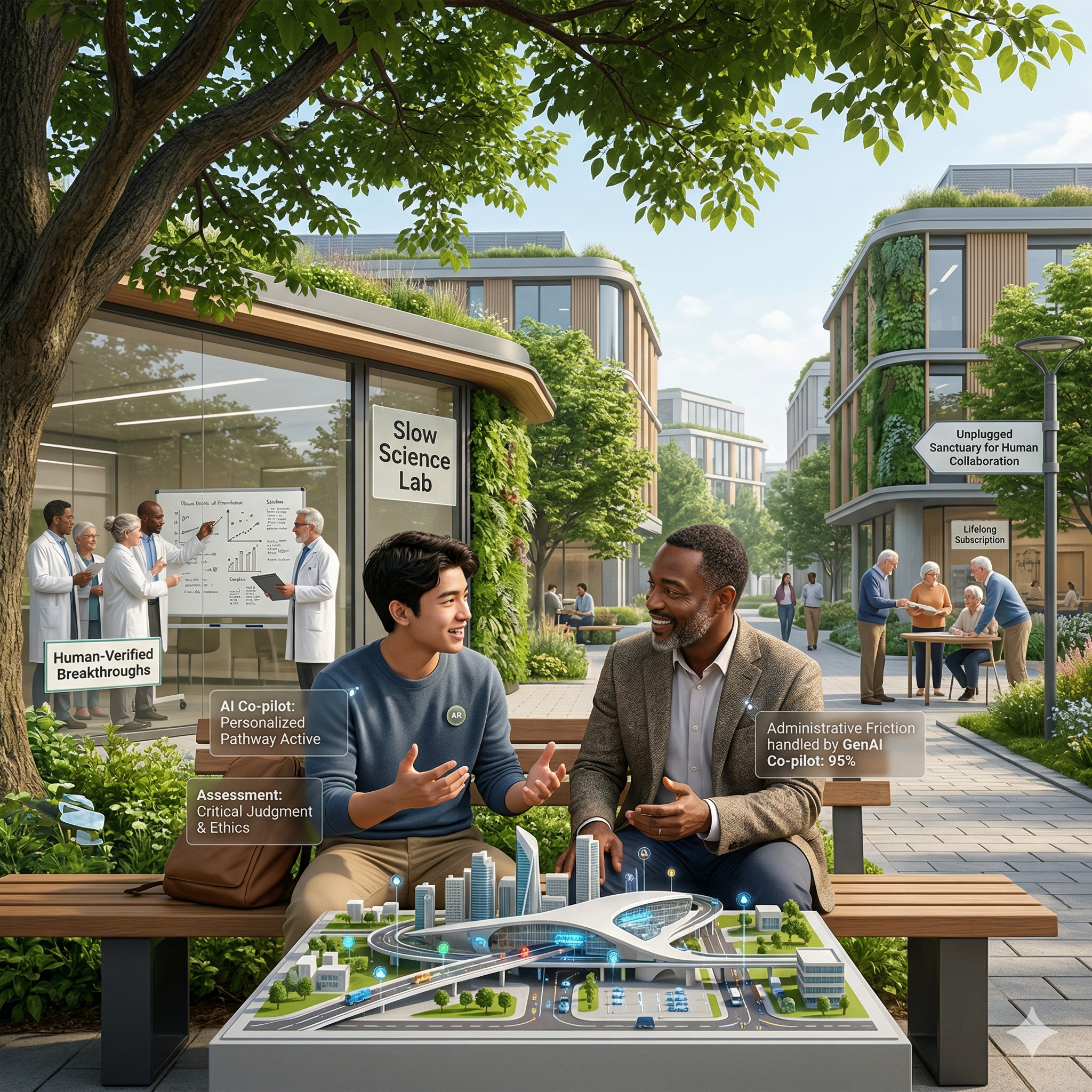
The most effective form of education in human history is the ancient “master-apprentice” dynamic. It is deeply personal, highly iterative, and utterly unscalable. To educate the masses, the industrial university sacrificed this intimacy for lecture halls and standardized testing. In the 5th Generation University, GenAI does not replace the teacher; it acts as the engine that finally allows us to scale the master-apprentice relationship.
- The AI Co-Pilot & Dynamic Pathways: By utilizing AI to handle the mass transfer of foundational knowledge and routine Q&A, we reduce the cognitive load for both students and educators. Furthermore, educational pathways will be optimized dynamically, much like a sophisticated supply chain, matching student needs with the right pedagogical resources at the exact right moment.
- The Human Mentor: When a student sits down with faculty in 2030, they aren’t asking for definitions. They are presenting an AI-assisted baseline solution to a complex problem and asking the professor for judgment. Consequently, assessments will completely shift from testing memory recall to evaluating how students ethically and critically navigate this AI-assisted problem-solving.
- Continuous Transformation & Unplugged Spaces: Degree programs will adapt in real-time to technological shifts rather than relying on slow, decadal reviews. Immersive graduate programs will blend technical AI fluency with deep domain expertise. Simultaneously, physical campus spaces must be deliberately redesigned as “unplugged sanctuaries” dedicated solely to the messy, collaborative human work that algorithms cannot simulate.
- The Lifelong Subscription: This model shatters the traditional timeline. The university can no longer be a “time-limited resort.” Because AI will continuously automate technical skills, the 2030 institution must operate as a lifelong subscription service, allowing alumni to continuously upskill their uniquely human competencies as the AI landscape shifts beneath them.
2. Research: The Call for “Slow Science”
Currently, academia is trapped in a “publish or perish” cycle that incentivizes volume over breakthrough. Generative AI is supercharging this flaw, threatening to flood academic journals with synthesized, low-stakes papers and fabricated data. To survive as the ultimate arbiter of truth, the university of 2030 must pivot to “Slow Science.”
- Human-Verified Rigor & Auditing: The university’s brand will rest on its strict epistemic standards, prioritizing rigorous, reproducible, human-verified research over AI-accelerated churn. To maintain our reputation as the anchor for objective truth, we will establish transparent, rigorous auditing protocols for all AI-generated data.
- Walled Gardens & Hybrid Methodologies: Institutional research data must be secured in enterprise-grade walled gardens to protect scholars’ intellectual property from public algorithmic scraping. Within these secure environments, innovation sciences will drive hybrid methodologies in which AI handles massive data processing while human experts steer the hypotheses.
- Living Labs & Interdisciplinary Hubs: Physical research domains will increasingly serve as living laboratories for testing AI optimization under real-world constraints. This work will be driven by interdisciplinary hubs that seamlessly integrate ethicists, industrial engineers, systems engineers, and data scientists to anticipate the societal fallout of emerging tech.
- Rewarding the Unknown: To fuel this, traditional incentive structures for tenure and promotion must be fundamentally overhauled to reward researchers for taking massive, multi-year risks rather than churning out incremental literature reviews.
3. Valorization and Impact: The Trust Engine
A university’s impact on society and industry will fundamentally change when corporations can generate their own R&D using enterprise AI. Society will no longer need us just for data; they will need us for our neutrality, our governance, and our care.
- The Ethical Sandbox & AI Governance: The 5th Gen University will serve as a neutral, ethical sandbox where industry partners can safely test the implications of new technologies before widespread public deployment. University-industry partnerships will pivot from purely transactional research to co-developing robust frameworks for responsible, human-centric AI governance.
- Translating Tech to Policy: Institutional leadership will actively shape public policy by translating complex AI advancements into clear, actionable advice for regional and global lawmakers, ensuring breakthroughs in engineering are applied to sustainable urban and global development. Spin-off companies will be incubated with a strict mandate to solve systemic societal bottlenecks rather than simply chasing short-term algorithmic efficiencies.
- The Regional Anchor: The university will act as a civic anchor, providing accessible “data hygiene” and vital AI literacy training to the surrounding community and workforce.
- Automate the Spreadsheet, Never the Care: To support this massive societal role, AI should be applied ruthlessly to eliminate back-office friction—scheduling, grant compliance, and resource allocation. But we must draw a hard line: we automate the spreadsheet, but we never automate the care. The resources freed by back-office automation must be intentionally redirected entirely toward human-to-human support on the front lines.
The Bottom Line
The 2030 university is not a factory for producing code or content. It is a forge for human judgment. By offloading the mechanical aspects of thought to Authentic Intelligence, we create an institution uniquely dedicated to the messy, brilliant, and irreplaceable qualities of the human mind.
 Tom Van Woensel