
The interface of Generative AI is deceptively ethereal. A blinking cursor on a stark white screen feels weightless, giving the illusion that artificial intelligence is a boundless, frictionless cloud.
But the cloud is incredibly heavy. It is made of concrete, steel, and lithium. AI feels like magic, but it runs on water and coal.
As we integrate these technologies into the core of our educational and operational frameworks, we have to confront an uncomfortable physical reality: Every single query has a physical footprint. —
The Semantic Cost of Compute
We are used to treating digital platforms as infinite resources. A Google search costs us nothing in visible energy, and we have transferred that expectation to Large Language Models.
However, research in 2026 makes it undeniable that the semantic meaning of a prompt heavily dictates its energy consumption. When you ask an AI to “summarize” a text or “list” five historical dates, the computational load—and therefore the electricity required—is relatively low.
But when you command an AI to “analyze,” “justify,” “synthesize,” or “debate,” you are triggering deep, multi-layered neural pathways. You are asking the machine to evaluate probabilities across billions of parameters. That cognitive friction translates directly into thermal output. Server farms must pump thousands of gallons of water to cool the hardware executing that single complex thought.
If we scale this across a university of thousands of students and faculty, querying these models multiple times a day, the environmental impact is staggering.
The Paradigm Shift: Cognitive Supply Chains
We already understand this principle in physical systems. In the optimization of freight and logistics networks, we do not send a fleet of half-empty trucks across a continent when a consolidated, algorithmically optimized rail route can achieve the same goal with a fraction of the carbon emissions. We meticulously engineer supply chains to eliminate redundant miles and minimize energy expenditure.
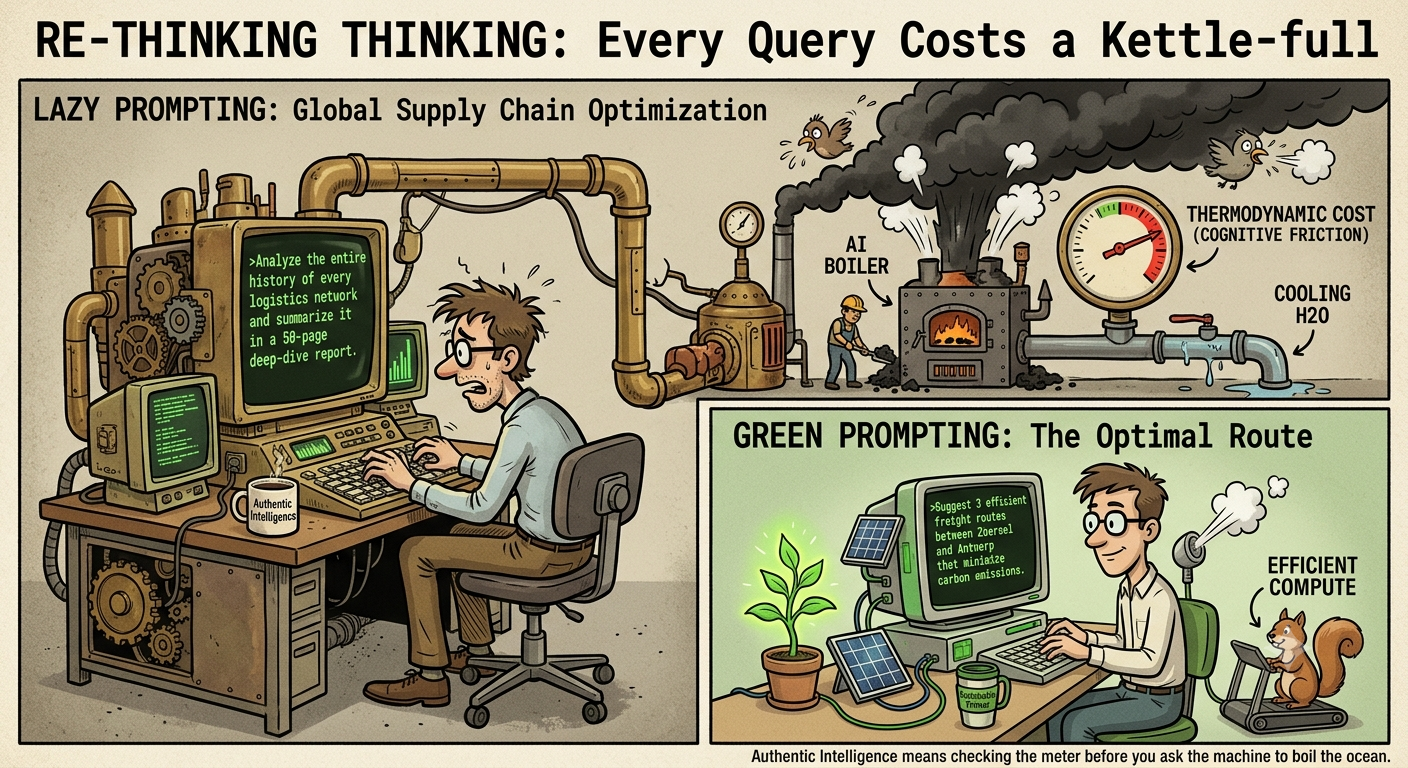
We must now apply this exact same operational discipline to our cognitive supply chains.
- Precision over Volume: A poorly framed, open-ended prompt forces the AI to expend massive amounts of compute searching for context. A highly constrained, well-defined prompt restricts the search space, saving energy.
- Iterative Efficiency: Instead of asking the AI to “generate a complete 50-page report” in one massive, energy-draining query, a sustainable workflow breaks the task down into precise, sequential steps, ensuring compute is only used exactly where human bandwidth falls short.
- Choosing the Right Vehicle: We do not need an enterprise-grade, massive neural network to fix a comma splice. Matching the complexity of the model to the complexity of the task is fundamental resource allocation.
The Ethics of Authentic Intelligence
The 5th Generation University cannot champion sustainability in its research while ignoring the thermodynamic cost of its own pedagogy.
Developing “Authentic Intelligence” is not just about teaching students how to get the right answer from a machine. It is about teaching them to weigh the ethical and physical cost of getting that answer.
When we treat our digital tools with the same rigorous efficiency that we apply to our physical supply chains, we move beyond mere AI literacy. We step into true algorithmic responsibility, ensuring that our pursuit of knowledge does not come at the expense of the planet that sustains it.

