Walk into any university board meeting today, and you will eventually hit the same administrative wall: We are out of space. Enrollments are growing, programs are expanding, and the physical campus is bursting at the seams. The university’s traditional reaction is to pour more concrete. We build sprawling new lecture halls and glass-walled megastructures.
But building more physical space to house an industrial-era teaching model is a massive misallocation of resources. We do not have a space shortage. We have an optimization problem.
Managing a university’s physical footprint is, fundamentally, a complex logistics challenge. Space and time are our finite resources, and student learning is the demand. For decades, our “supply chain” of education has been incredibly inefficient, forcing thousands of students into 500-seat amphitheaters at rigid times to passively consume information.
In the 5th Generation University, we stop building new “warehouses”. Instead, we use Authentic Intelligence to completely rewire how, when, and where learning happens, solving the space crisis not with bricks, but with bandwidth.
The Inefficiency of the Mega-Lecture
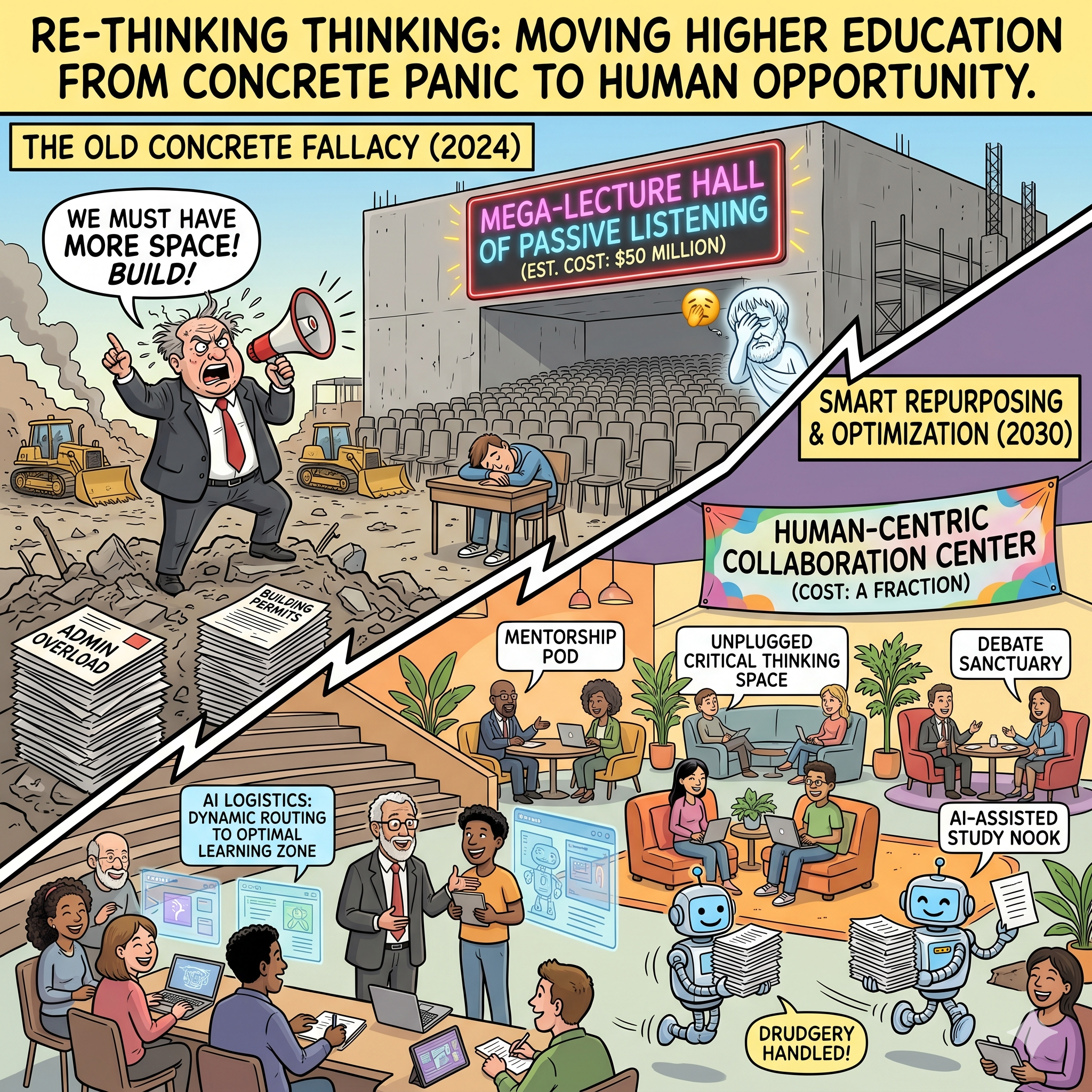
To understand the solution, we have to look at the waste. The traditional 500-seat lecture hall is the least efficient real estate on a modern campus. It is expensive to build and to heat, and it sits empty for much of the week. Worse, the pedagogical value of gathering 500 people in one room just to watch a human read from a PowerPoint is practically zero.
When we integrate GenAI as a personalized co-pilot for foundational knowledge transfer, the need for the mega-lecture evaporates. If a student can master the basic syntax of coding or the timeline of a historical event from their dorm room or a local café with an AI tutor, we no longer need to physically house them in massive groups for passive listening.
The “Flipped Campus” Strategy
By offloading the mechanical transfer of information to AI, we can transition from a “Flipped Classroom” to a Flipped Campus. Here is how AI optimizes our physical footprint:
- Decommissioning the Amphitheater: We stop building giant, single-use lecture halls. The capital saved (often tens of millions of euros) is redirected from real estate development into human capital, hiring more faculty to act as mentors and coaches.
- Repurposing for High-Friction Learning: The physical space we do have is radically repurposed. Campuses should consist entirely of smaller, high-impact “unplugged sanctuaries.” These are seminar rooms, collaborative labs, and debate spaces. We bring students to campus strictly for the messy, high-friction human interactions that algorithms cannot simulate.
- Dynamic Space Allocation: Instead of booking a room for an entire semester regardless of attendance, we can use AI logistics to dynamically route students and faculty to appropriate spaces based on real-time pedagogical needs. If an AI dashboard detects that a cohort of 12 students is struggling with a specific systemic bottleneck, it triggers a physical, in-person master-apprentice session in a small huddle room.
The End of the Synchronous Logjam
The campus space crisis is artificially inflated by our adherence to rigid, synchronous schedules. We try to move 10,000 students across a campus at the exact same time, on the hour, every Monday, Wednesday, and Friday.
By treating the university as a lifelong, hyper-personalized subscription service enabled by GenAI, we break the synchronous logjam. Learning becomes asynchronous and continuous. Students access the “drudgery” of education on their own time, decentralizing the physical demand on the campus infrastructure. The physical university transforms from a daily mandatory holding pen into a targeted destination for deep human connection and verification.
The Bottom Line
Every euro spent on pouring concrete for a new lecture hall is a euro stolen from the core mission of human mentorship.
We do not need to expand our physical borders to accommodate the future of education. By embracing AI to handle the mass-transfer of basic knowledge, we can shrink our required footprint, eliminate logistical waste, and redesign our existing spaces to be purely, unapologetically human.
This post presents my perspective on the transformative potential of artificial intelligence (AI) in reshaping educational practices, particularly at the university level, through constructive alignment. It was developed using a multi-stage, AI-assisted process that combined human insights with interactions across various AI systems. This collaborative approach aimed to ensure clarity, coherence, and relevance while significantly reducing the effort required to structure and articulate ideas effectively. The creation process involved leveraging Gemini and ChatGPT to identify pertinent references from current academic discourse. The AIgenerated outputs were converted and underwent manual revisions and refinements.

