When driving the transformation of our educational programs, the most common fear we hear from faculty is the lack of time.
If we advocate for a return to the deeply personal “master-apprentice” model of education, the immediate assumption is that the system will collapse under the weight of the workload. We picture a professor’s current, already-overloaded schedule, and then we imagine simply adding personalized mentorship and 15-minute oral exams for 300 students on top of it.
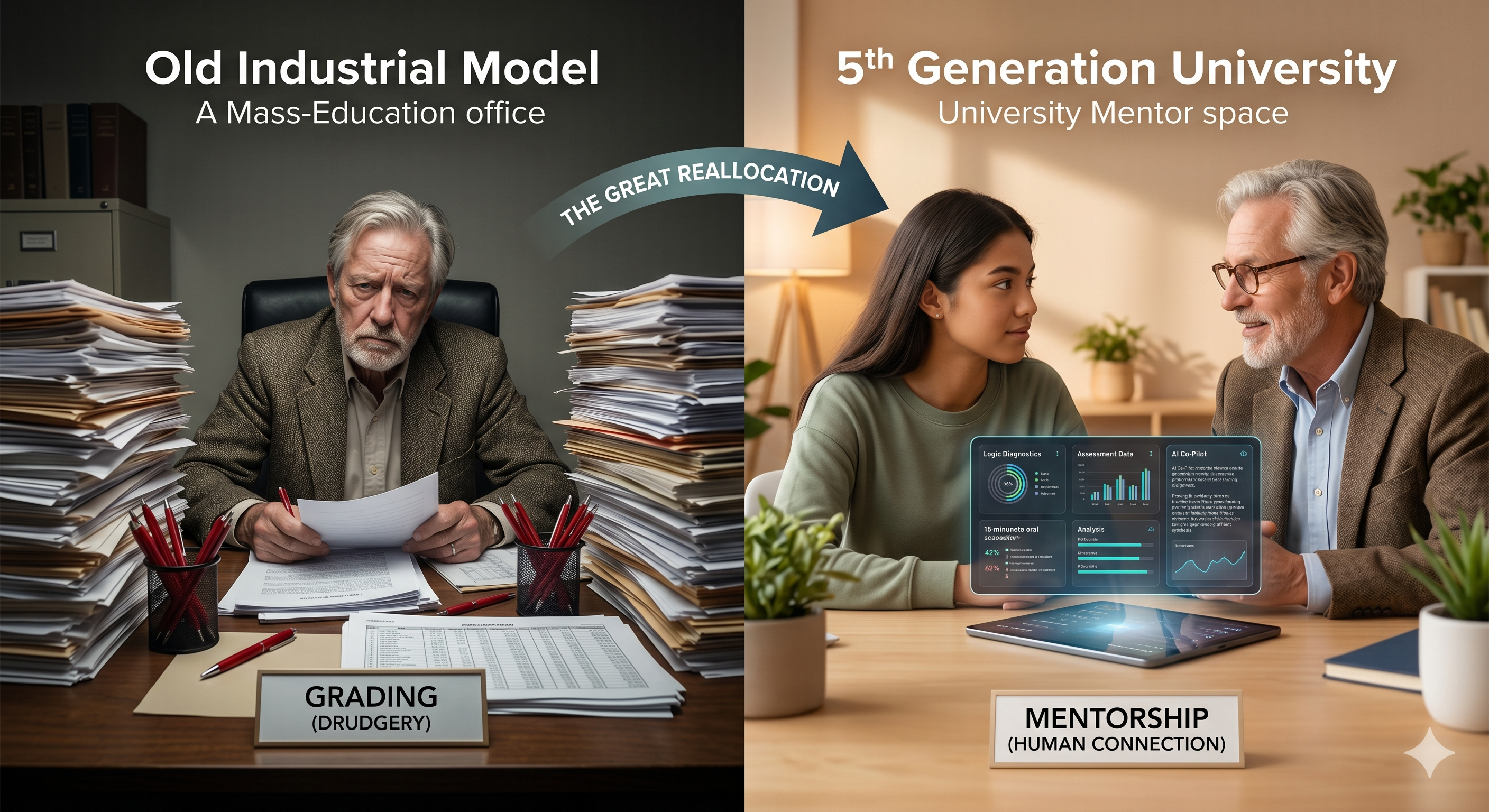
But this fear rests on a fundamental misunderstanding of what a true AI transformation looks like. We are not adding new tasks on top of the old industrial model. We are dismantling the industrial model entirely. Artificial Intelligence is not here to replace the human educator; it is here to support them. It is a ruthless optimizer of human effort. The time investment required for this Next-Generation University is not additional. It is a reallocation of hours from administrative friction to human connection.
Here is how we execute this shift:
1. The “Drudgery Swap” (Time Reallocation, Not Addition)
The current industrial model of mass education is highly inefficient. Faculty spend an enormous percentage of their week on low-yield tasks: delivering static lectures, answering repetitive logistical questions at midnight, and batch-grading basic syntax or knowledge-recall errors.
- The AI Support Engine: GenAI absorbs this drudgery. An AI Co-Pilot handles baseline knowledge transfer and provides instant, 24/7 feedback on first drafts.
- The Human Result: Faculty reclaim hundreds of hours per semester. We are not asking professors to work more hours; we are shifting their existing hours away from the spreadsheet and the red pen, and redirecting that exact same time directly to the student.
2. High-Yield Interactions (The Triage Effect)
In the traditional mass-education model, when a student finally makes it to office hours, the first 20 minutes are entirely consumed by diagnosing what the student doesn’t understand.
- The AI Support Engine: AI acts as a continuous cognitive diagnostic tool. Before a student even walks through your door, a dashboard can highlight exactly where their logic broke down during their AI-assisted study sessions.
- The Human Result: Because the problem is pre-diagnosed, a 15-minute interaction becomes incredibly potent. The professor spends that time strictly on high-level synthesis, ethical judgment, and deep problem-solving. This creates a massive increase in the Return on Investment (ROI) of faculty time.
3. The Efficiency of the Authentic Assessment
Administrators are often terrified of oral exams due to the perceived time commitment. But in the AI era, traditional written exams are actually less efficient. They require complex plagiarism detection, defensive grading, and constant, exhausting curriculum rewriting just to outsmart the bots.
- The AI Support Engine: The oral exam is no longer a solo endeavor. The AI acts as the silent scribe, recording, transcribing, and mapping the student’s verbal arguments against the grading rubric in real-time.
- The Human Result: A 10-minute oral defense reveals more about a student’s true mastery and critical thinking than a 15-page essay ever could. Freed from taking frantic notes, the professor can focus entirely on probing the student’s intellect, reviewing the AI’s suggested assessment afterward to make the final, irreplaceable human judgment.
4. Expanding the Human Network (Peer-to-Peer Scaling)
We mistakenly assume that “mentor-apprentice” must always mean a one-to-one ratio of “Professor-to-Student,” which feels unscalable.
- The AI Support Engine: A hyper-personalized university leverages its entire community. AI logistics can dynamically match advanced undergraduate or graduate students with freshmen who are struggling with specific concepts.
- The Human Result: This scales the mentorship model exponentially. It provides younger students with relatable human guidance while giving older students invaluable leadership and teaching experience—vital human skills for the future workforce.
5. Exposing the True Cost of the Status Quo
Defenders of the mass-education model argue that huge lecture halls are cheap and efficient. But they are only looking at a fraction of the balance sheet.
The industrial model produces staggering invisible costs: high dropout rates, profound student disengagement, mental health crises, and graduates who require immediate retraining by their employers. Conversely, the master-apprentice model fosters deep engagement and a sense of belonging. When students feel seen and known by a mentor, retention rates soar. Economically, the cost of losing a student halfway through their degree far outweighs the investment required to scale personalized, human-to-human mentorship.
Embracing AI does not mean handing our students over to the machines. It means using the machines to clear the administrative brush, so we can finally get back to the deeply human work of teaching.
 Tom Van Woensel