
In a previous post, we discussed that the ethereal “cloud” of artificial intelligence is actually a heavy, physical infrastructure running on water and electricity. But acknowledging the carbon footprint of Generative AI is only the first step. To execute a responsible, university-wide transformation of our educational programs, we must move from awareness to operational strategy.
We need to formalize the practice of Greener Prompting. We must adopt a “GreenPT” mindset.
In freight transport and logistics, the fundamental law is efficiency: we do not dispatch a heavy-duty articulated lorry to deliver a single envelope, and we do not route a fleet of trucks without rigorously optimizing their path to eliminate redundant miles. Yet, in the academic integration of AI, we are doing exactly that. We are letting students and faculty send poorly routed, computationally massive queries into data centers for the cognitive equivalent of delivering a single envelope.
Every unoptimized prompt is a misrouted truck burning excess fuel. Greener prompting is the science of optimizing our cognitive supply chain.
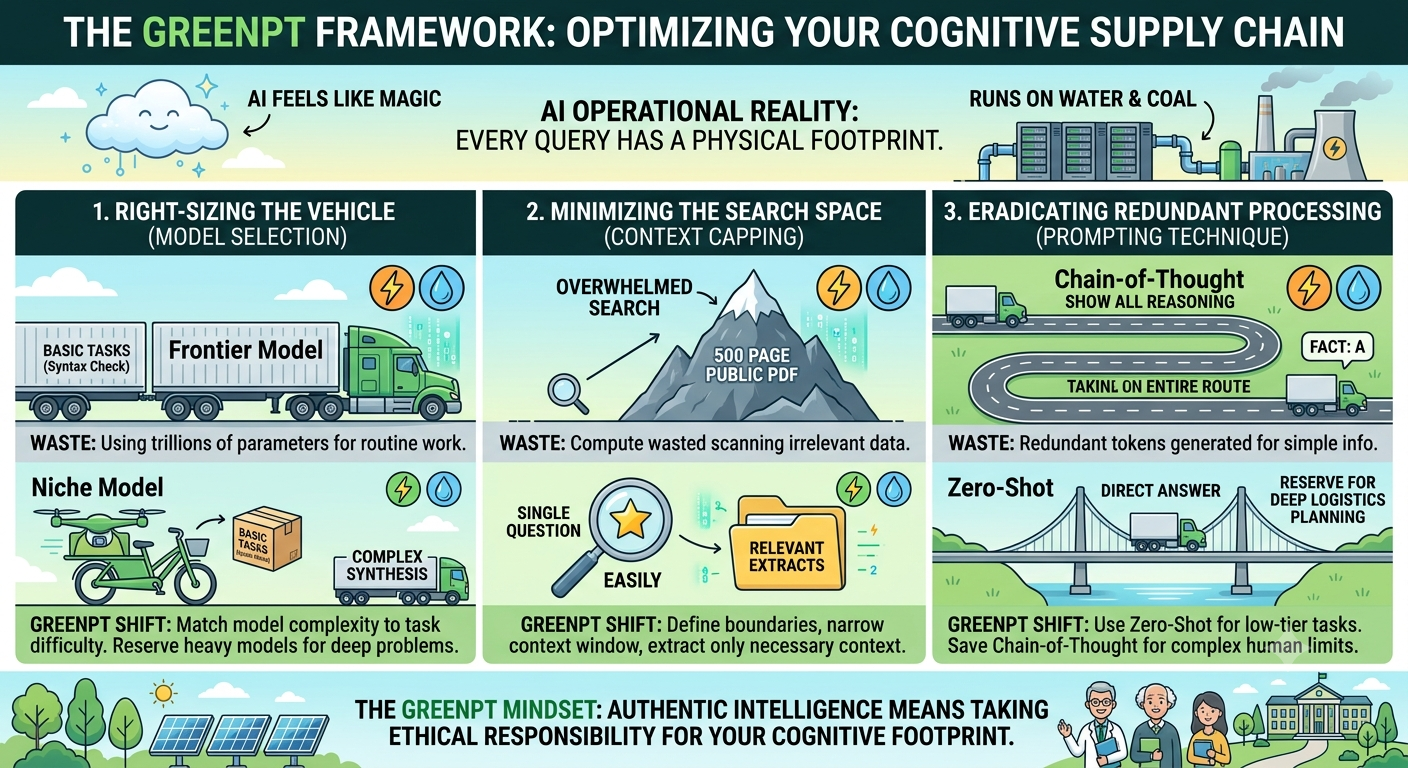
The Mechanics of Green Prompting
To teach sustainable AI literacy, we must train our academic community to right-size their computational requests. This involves three practical shifts in how we interact with the machine:
1. Right-Sizing the Vehicle (Model Selection)
The most common error in everyday AI usage is defaulting to the largest, most parameter-heavy model available (the “heavy-duty lorry”) for every single task.
- The Waste: Using a frontier model with a trillion parameters just to check the syntax of a paragraph or summarize a basic text is a massive waste of electricity and cooling water.
- The GreenPT Shift: We must teach users to match the complexity of the model to the complexity of the task. Use smaller, faster, and exponentially greener models for administrative drafting and basic coding, reserving the energy-intensive frontier models exclusively for deep, multi-variable problem solving and complex synthesis.
2. Minimizing the Search Space (Context Capping)
Generative AI models consume energy relative to the amount of context they have to process.
- The Waste: Uploading a 500-page PDF and asking, “What does this say about European port infrastructure?” forces the algorithm to expend compute scanning hundreds of irrelevant pages.
- The GreenPT Shift: Restrict the parameters. Extract and upload only the relevant two chapters. By defining strict boundaries and narrowing the context window, you drastically reduce the processing time and the thermodynamic cost of the query.
3. Eradicating Redundant Processing (Zero-Shot vs. Chain-of-Thought)
Different prompting techniques trigger different levels of algorithmic processing.
- The Waste: Using a “Chain-of-Thought” prompt (e.g., commanding the AI to “think step-by-step and show all your reasoning”) is brilliant for complex mathematics or strategic logistics planning. However, using it for simple information retrieval forces the machine to generate and process unnecessary tokens, spiking its energy footprint.
- The GreenPT Shift: Apply “Zero-Shot” (direct question, direct answer) prompting for low-tier tasks. Reserve heavy, iterative prompting architectures only for moments where human cognitive limits require the machine to show its work.
Carbon Literacy is AI Literacy
We cannot separate our technological ambitions from our environmental realities. As we redesign our curriculum for the 5th Generation University, we are not just teaching students how to get better answers; we are teaching them how to build highly efficient, sustainable systems.
A brilliant prompt that wastes massive amounts of compute because of lazy framing is no longer acceptable. Authentic Intelligence demands that we take ownership of the physical impact of our digital tools. By embedding the “GreenPT” mindset into our daily operations, we ensure that our pursuit of innovation does not break the physical networks that sustain us.
This post presents my perspective on the transformative potential of artificial intelligence (AI) in reshaping educational practices, particularly at the university level, through constructive alignment. It was developed using a multi-stage, AI-assisted process that combined human insights with interactions across various AI systems. This collaborative approach aimed to ensure clarity, coherence, and relevance while significantly reducing the effort required to structure and articulate ideas effectively. The creation process involved leveraging Gemini and ChatGPT to identify pertinent references from current academic discourse. The AIgenerated outputs were converted and underwent manual revisions and refinements.

