
A shadow hangs over academic publishing: the fear of the synthetic flood. Critics envision a bleak future where automated pipelines churn out low-quality papers, peer review collapses under the weight of AI-generated noise, and scientific inquiry devolves into algorithmic echo chambers.
This fear is entirely valid if we view AI as an author. But if we view it as a catalyst, the exact opposite becomes possible. Generative AI is not the death of academic rigor. It is the engine that can finally revive “Slow Science.”
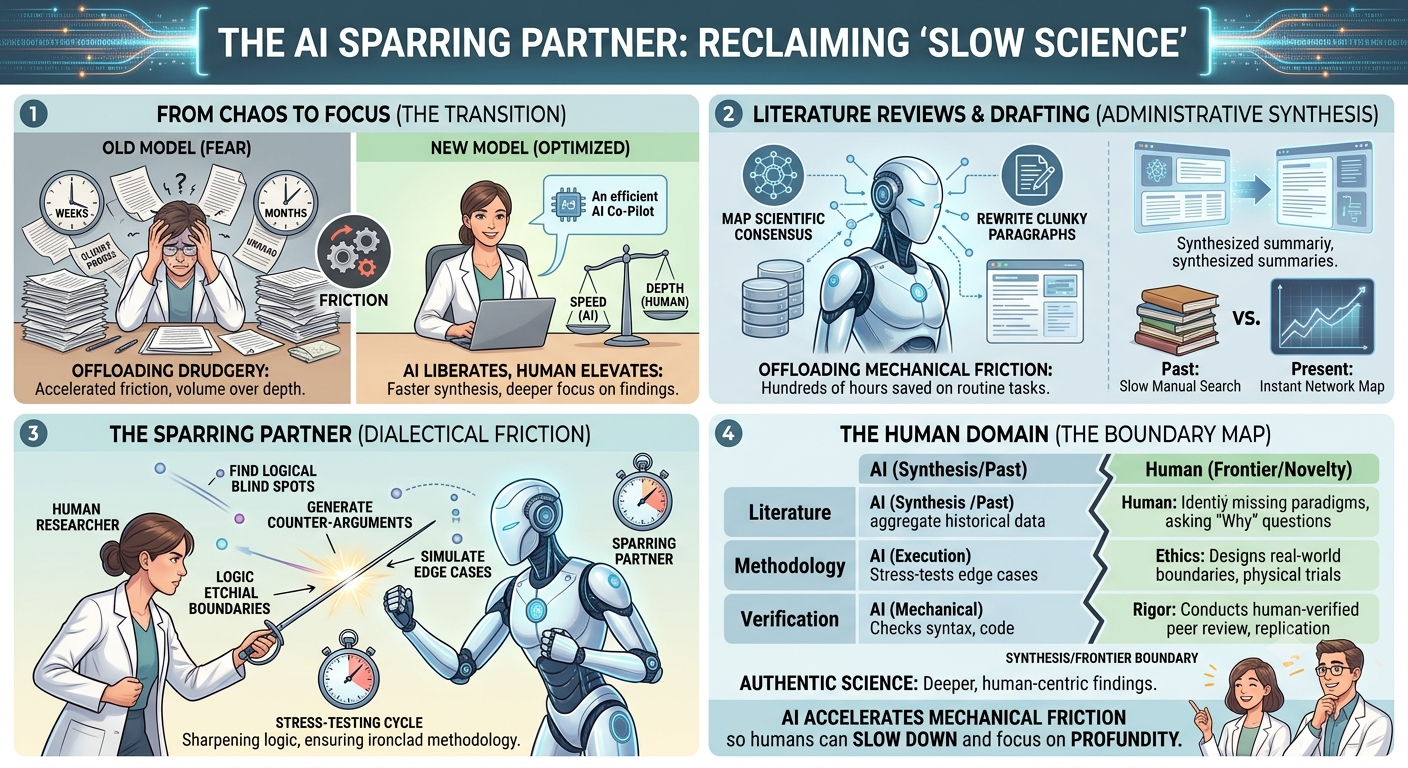
1. Offloading Mechanical Friction
Science has become bogged down by administrative and mechanical drag. Before a researcher can test a groundbreaking hypothesis, they must spend months wading through thousands of papers, formatting citations, distilling consensus across disparate literature, and refining clunky prose.
Generative AI excels at this mechanical synthesis. It can map existing scientific consensus across massive datasets in minutes, highlight contradictions in historical literature, and streamline academic writing.
Absorbing operational friction does not cheapen research. It liberates the researcher to actually think.
2. The Algorithmic Red Team: AI as a Sparring Partner
The most transformative value of GenAI in research is not text generation; it is dialectical friction.
Instead of using AI to write conclusions, scholars can deploy advanced models as a “sparring partner” to stress-test hypotheses before stepping into the lab or field:
- Finding Logical Blind Spots: Prompting an AI to act as an adversarial peer reviewer, searching for unstated assumptions, missing control variables, or flaws in an experimental setup.
- Generating Counter-Arguments: Forcing an argument to defend itself against alternative data interpretations, ensuring the methodology is ironclad early in the research cycle.
- Simulating Edge Cases: Stress-testing mathematical, physical, or supply-chain models against rare, multi-variable disruption scenarios.
This turns AI into an intellectual simulator: a tool that sharpens human logic rather than replacing it.
3. Protecting the Human Frontier
To preserve academic integrity, we must draw a sharp boundary between mechanical synthesis and true intellectual breakthroughs.
| Research Phase | The AI’s Role (Synthesis) | The Human’s Imperative (Frontier) |
| Literature | Mapping consensus & aggregating historical data | Identifying missing paradigms & asking novel “Why” questions |
| Methodology | Stress-testing logic & spotting edge cases | Designing ethical parameters, physical trials, & real-world boundaries |
| Verification | Checking syntax, code, & formatting | Conducting rigorous, human-verified replication & peer review |
AI synthesizes what is already known. The human researcher operates exclusively on the frontier—generating novel hypotheses, wrestling with complex ethical implications, and anchoring findings in objective truth.
The Paradox of Speed for “Slow Science”
For decades, the industrial “publish or perish” cycle incentivized speed and volume over depth and reproducibility. Generative AI supercharges that rat race only if we use it to churn out content.
If we deploy it strategically, AI accelerates the mechanical friction of research so human scholars can slow down and focus on the profundity of their discoveries. We do not need a higher volume of average papers; we need deeper, human-verified insights. By transforming AI from an essay-generator into an unyielding sparring partner, we reclaim the time required to practice genuine, transformative science.

