When universities face the disruption of Generative AI, the most frequent institutional reflex is prohibition. We draft sweeping honor code revisions, deploy AI-detection software, and attempt to ban algorithms from the assessment process entirely, all in the name of preserving academic integrity.
But we must confront an uncomfortable truth about these policies: Banning AI doesn’t protect academic integrity. It just protects wealthy students.
Attempting to outlaw artificial intelligence in higher education does not stop its use. It simply drives the technology underground, creating a massive, invisible equity crisis. If we want to build a truly equitable 5th Generation University, we must fundamentally change how we view access to these tools.
The New Digital Divide and the Shadow Economy
Historically, the academic digital divide was defined by hardware: who could afford a laptop, and who had reliable broadband. In the 2030s, the digital divide is entirely cognitive.
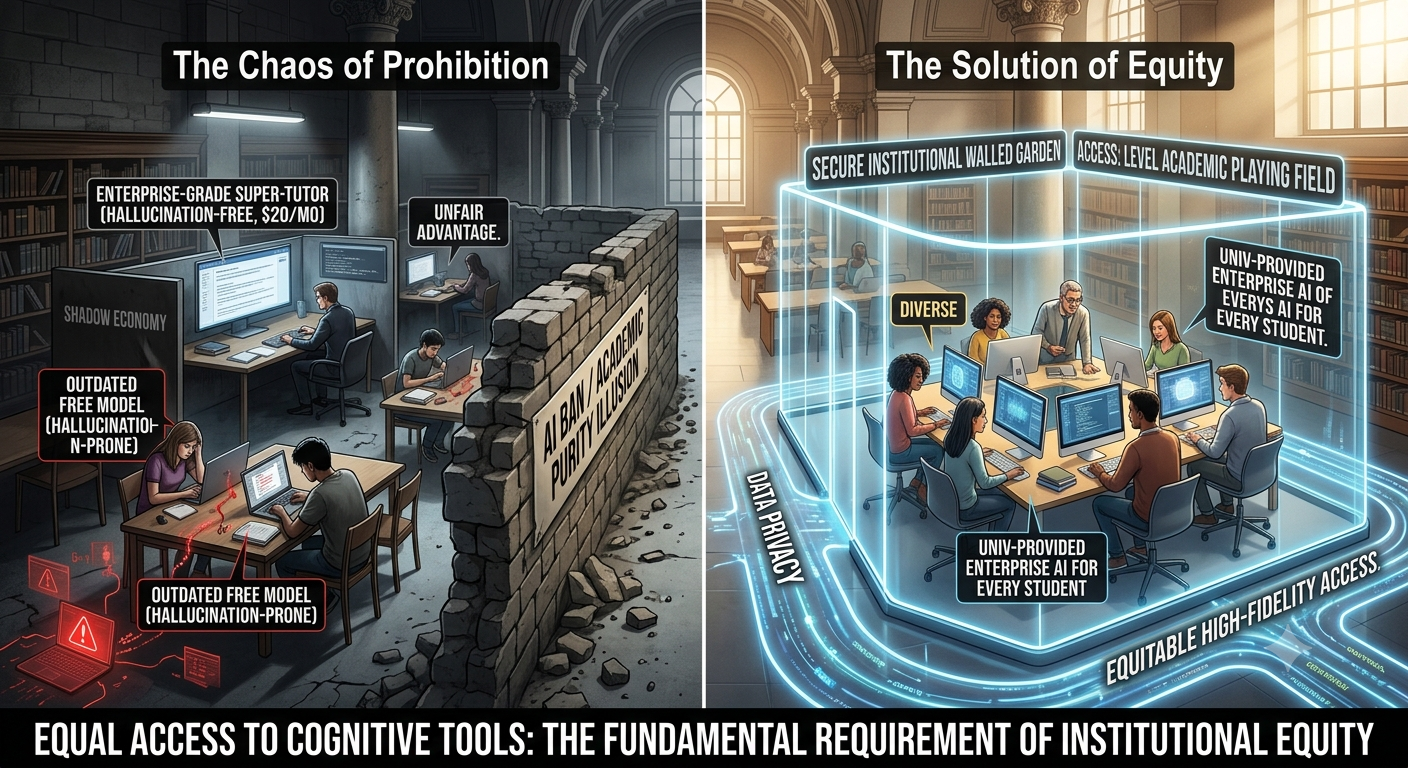
When a university officially bans AI, it creates an unregulated shadow economy. In this environment, a student with disposable income will quietly pay the 20-euro-a-month subscription for an enterprise-grade, hallucination-free model. They gain access to a brilliant, 24/7 private “super-tutor” that can flawlessly synthesize complex topics, stress-test their arguments, and debug their code.
Meanwhile, a disadvantaged student, trying to follow the rules, or unable to afford the premium subscription, is left to compete using outdated, hallucination-prone free models, or nothing at all.
We are inadvertently manufacturing an asymmetric advantage. The premium AI user isn’t just working faster; they are thinking with a higher-fidelity cognitive partner. If we ignore this reality, we are effectively grading students not on their innate intellect or work ethic, but on their software subscription tier.
The Data Privacy Crisis
Beyond the equity issue, relying on consumer-grade AI models creates a severe institutional vulnerability. When students use free, public AI tools to analyze datasets, draft essays, or write code, they are often unknowingly feeding their intellectual property, and the university’s research data, back into the public training models of tech conglomerates.
We cannot expect students to navigate the complex terms of service of global tech companies on their own. The institution must intervene.
The Solution: Building an Institutional “Walled Garden”
The solution to both the equity crisis and the privacy crisis is the same: the university must step up as the provider. We must build and maintain secure, enterprise-level “Walled Gardens.”
A walled garden is a secure, institutionally licensed AI ecosystem. It guarantees two critical things:
- Absolute Data Privacy: The inputs, queries, and research data generated by students and faculty remain entirely within the university’s secure perimeter. They are never used to train external public models.
- Equitable High-Fidelity Access: Every single enrolled student, regardless of their socioeconomic background, logs into the exact same enterprise-grade cognitive tools.
Equal Access as a Utility
We do not ask students to pay a monthly subscription to turn on the lights in the lecture hall, nor do we ask them to swipe a credit card to access peer-reviewed journals in the university library. We consider these utilities foundational to the academic experience.
In the AI era, cognitive tools are the new utilities. Equal access to high-fidelity, hallucination-free AI is no longer a luxury or an IT perk; it is a fundamental requirement of institutional equity. Embracing AI is not about lowering our standards. It is the moral imperative required to keep the academic playing field strictly level.

