Let us start with an uncomfortable truth. If an algorithm can pass your final exam in three seconds, your exam is broken.
When a Generative AI easily aces a midterm, the institutional reflex is often to blame the technology, deploying draconian surveillance software or banning laptops in the lecture hall. But the AI is just a mirror. It is reflecting the reality that we are testing the wrong things. It does not mean the machine is a genius; it means our assessment model is obsolete.
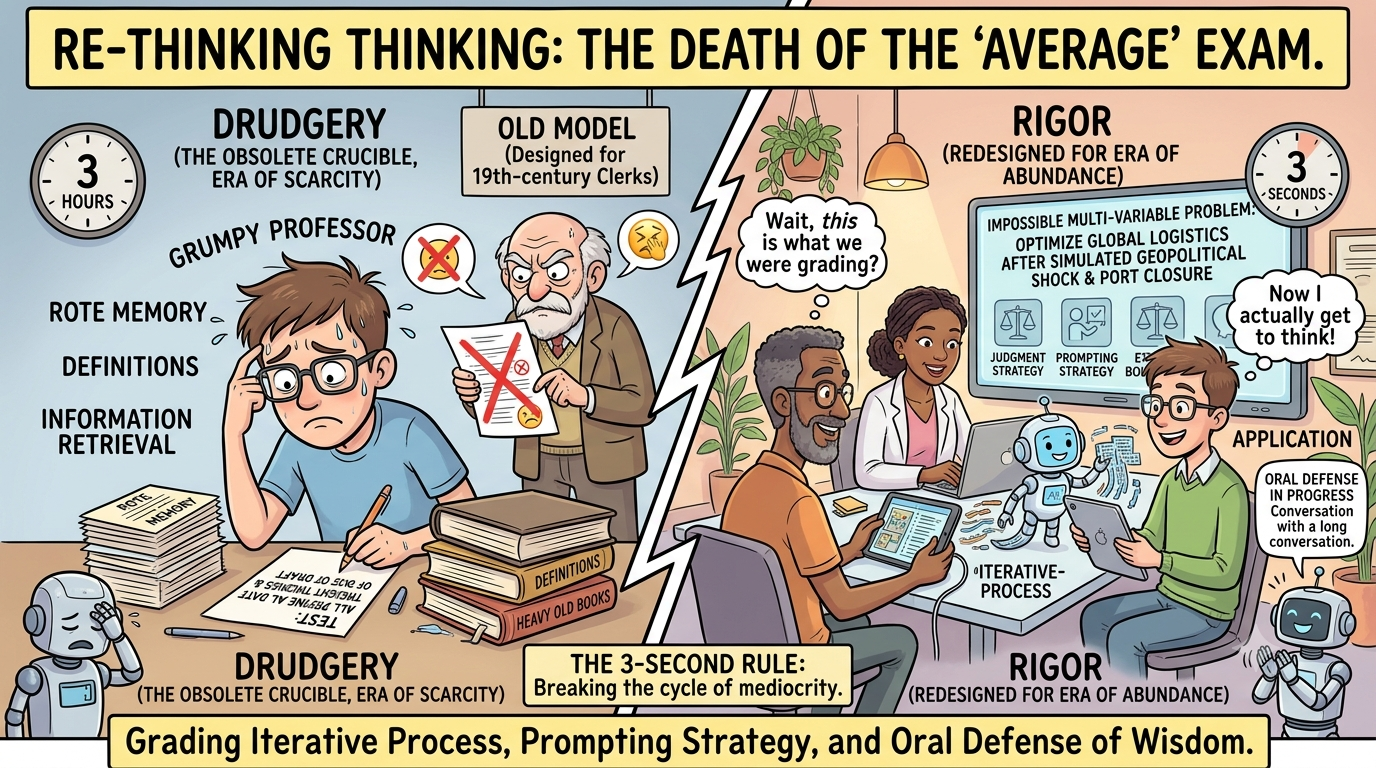
The traditional multiple-choice test and the standard academic essay were brilliant inventions—for an era of information scarcity. When knowledge was locked in physical libraries, testing a student’s ability to memorize, retrieve, and synthesize that information was a valid measure of competence.
Today, GenAI has completely commoditized information retrieval. A machine can perfectly define a complex framework in milliseconds. If we are still assessing a student’s ability to recall definitions or generate “average” summaries, we are certifying them for a world that no longer exists.
We must redesign assessment from the ground up. We must stop testing retrieval and start testing application.
The Shift: Embracing the Multi-Variable Reality
In a 5th Generation University, the assessment must mirror the complexity of the professional arena our graduates are about to enter. We have to move toward complex, multi-variable, problem-based learning.
Consider the reality of modern supply chain management. We must stop asking students to define basic freight transport theories on a piece of paper. Instead, the assessment should look like this:
- We hand the student a massive, unstructured historical dataset of a global logistics network.
- We provide them with an enterprise-grade AI co-pilot.
- We introduce a simulated, multi-variable geopolitical shock—a sudden port closure in Europe combined with a spike in regional fuel costs.
- The Task: Use the AI to optimize the network, establish alternative routing, calculate the new risk percentages, and present a viable strategy.
In this scenario, the AI does the heavy computational lifting. But the student has to know the underlying theory to write the correct prompts, and they have to possess the critical judgment to verify if the AI’s proposed route actually works in the physical world.
Grading the Process, Not the Product
If the AI is doing the drafting and calculating, how do we grade the student?
We stop grading the final, static product. The perfectly formatted essay or the clean spreadsheet is no longer proof of learning; it is merely proof that the student knows how to click “generate.”
Instead, we shift our rubrics to evaluate the friction and the judgment:
- The Iterative Process: We assess the student’s methodology. How did they break down the problem? How did they structure their data before feeding it to the machine?
- The Prompting Strategy: We evaluate their cognitive steering. Did they ask shallow questions, or did they use targeted, constraint-based prompting to force the AI into rigorous analysis?
- The Oral Defense: This is the ultimate crucible. The student must sit across from the professor and defend the AI’s output. They must explain why the algorithm made a specific choice, identify where the model’s logic is weak, and justify the ethical or physical boundaries of the solution.
The death of the ‘average’ exam is not a loss; it is a profound pedagogical upgrade. By offloading rote memorization to the machine, we are finally forced to test the uniquely human traits that algorithms lack: critical taste, verifiable logic, and strategic, authentic judgment.
This post presents my perspective on the transformative potential of artificial intelligence (AI) in reshaping educational practices, particularly at the university level, through constructive alignment. It was developed using a multi-stage, AI-assisted process that combined human insights with interactions across various AI systems. This collaborative approach aimed to ensure clarity, coherence, and relevance while significantly reducing the effort required to structure and articulate ideas effectively. The creation process involved leveraging Gemini and ChatGPT to identify pertinent references from current academic discourse. The AIgenerated outputs were converted and underwent manual revisions and refinements.

